

 All products
Filter by display-type


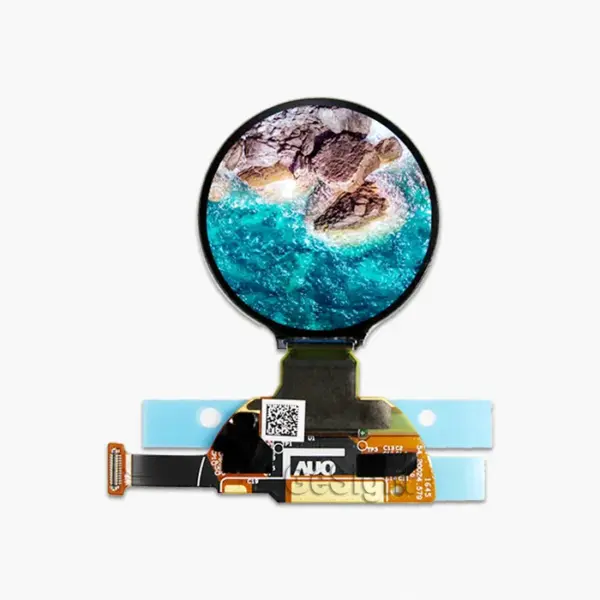
1.2-inch Circular 390×390 AMOLED Display
| Size |
1.2 inch |
|---|---|
| Pixels |
390 × 390 |
| Interface | , |
| Brightness |
300 min, 350 typ, nits |
| Manufacturer |
Gesight |
| Display Type |
AMOLED |
| Display Mode |
AMOLED |
| Color Depth | |
| Refresh Rate |
– |
| Viewing Angle Range |
Top 80°, Bottom 80°, Left 80°, Right 80° (CR > 1600) |
| Outline L*W*H |
33.22 × 34.72 × 0.66 mm |
| Active Area L*W |
30.42 × 30.42 mm |
| Orientation | |
| Supply Voltage |
VDDIO: 1.65 / 1.8 / 1.95 V (min/typ/max); VCI: 3.27 / 3.3 / 3.33 V; ELVDD: 3.27 / 3.3 / 3.33 V; ELVSS: -3.33 / -3.3 / -3.27 V |
| Consumption |
Panel power (full white, 350 nits): 128.7 mW typ; IOLED: 19.5 mA typ; IC Normal: PVCI 5.3 mW typ, PVDDIO 3.5 mW typ; Idle: PVCI 4.5 mW typ, PVDDIO 2.4 mW typ; Sleep: PVCI < 0.075 mW, PVDDIO < 0.1 mW |
| Operating Temperarure |
−30 to +70 °C |
| Storage Temperature |
−30 to +80 °C |
| Bezel Area (mm) |
Derived from outline vs active: (33.22-30.42)=2.80 mm; (34.72-30.42)=4.30 mm. Per-side bezel: Left/Right 1.40 mm; Top/Bottom 2.15 mm |
| Aspect Ratio |
1:1 |
| Connection Type |
FPC, 24-pin; recommended connector BM28B0.6-24DP/2-0.35V(51) / BM28B0.6-24DS/2-0.35V(51) |
| IC package |
– |
| Touch Panel | |
| Pixel Pitch |
Derived: 30.42 mm / 390 = 0.0780 mm (78.0 µm) |
| Sunlight Readable |
– |
| Model |
PO120F390MS |
| PPI ( pixels per inch ) |
326 PPI |
| Application |
Display terminals for Round Watch |
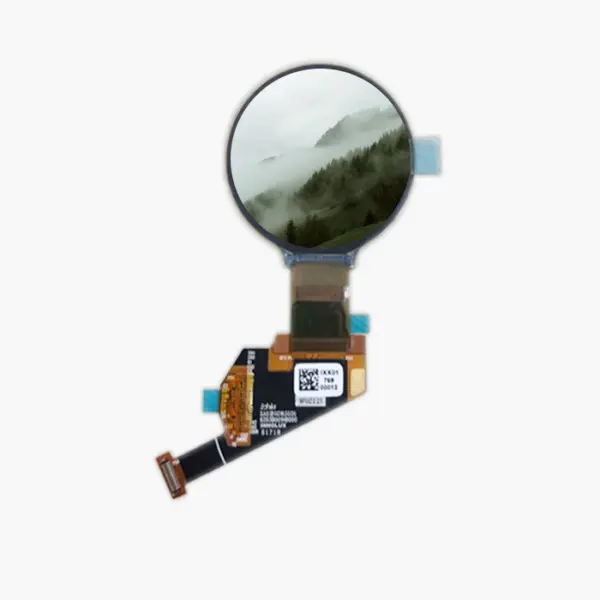
1.39-inch Flexible/Bendable OLED Display 400×400 MIPI
| Size |
1.39 inch |
|---|---|
| Pixels |
400 × 400 |
| Interface | |
| Brightness |
300 cd/m² (typ), 250 cd/m² (min) |
| Manufacturer |
Gesight |
| Display Type |
AMOLED ,Flexible OLED |
| Display Mode |
AMOLED (LTPS-AMOLED) |
| Color Depth | |
| Refresh Rate |
60 Hz |
| Viewing Angle Range |
Top 80° / Bottom 80° / Left 80° / Right 80° (CR > 1600) |
| Outline L*W*H |
38.6 (H) × 40.5 (V) × 0.7 typ, 0.8 max (T), w/o FPCa (mm) |
| Active Area L*W |
Ø35.4 mm (Diameter) |
| Orientation | |
| Supply Voltage |
VVCI: 2.7–3.6 V (typ 2.8 V); VDDIO: 1.65–3.3 V (typ 1.8 V); ELVDD: 4.55–4.65 V (typ 4.6 V); ELVSS: −2.35 to −2.45 V (typ −2.4 V) |
| Consumption |
Current (typ) at VDDIO=1.8 V, VCI=2.8 |
| Operating Temperarure |
−30 to +70 °C |
| Storage Temperature |
−30 to +70 °C |
| Bezel Area (mm) |
– |
| Aspect Ratio |
1:1 (400×400) |
| Connection Type |
FPCa; FPCA recommended connector: Molex 504248-2410 (24 pins); Main board recommended connector: Molex 504208-2410 |
| IC package |
COF |
| Touch Panel | |
| Pixel Pitch |
0.0885 (H) × 0.0885 (V) mm |
| Sunlight Readable |
– |
| Model |
PO139FN01F |
| PPI ( pixels per inch ) |
287 PPI |
| Application |
– |
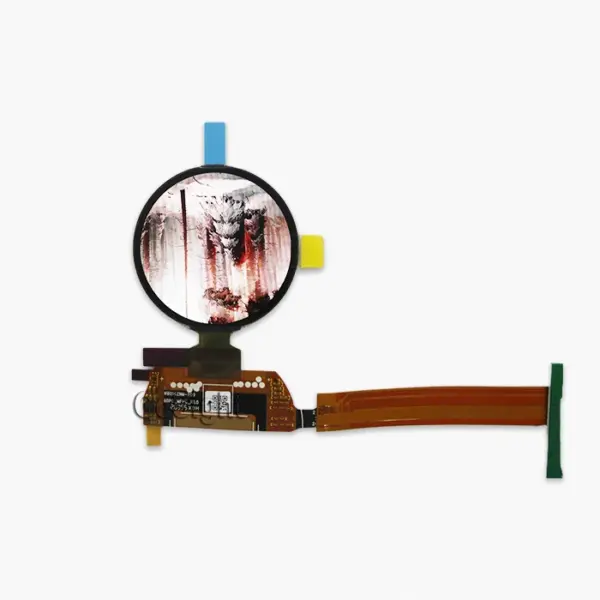
1.39-inch Circular AMOLED Display 454×454
| Size |
1.39 inch |
|---|---|
| Pixels |
454RGB × 454 |
| Interface | , |
| Brightness |
450 cd/m² (typ) |
| Manufacturer |
Gesight |
| Display Type |
AMOLED |
| Display Mode |
AMOLED |
| Color Depth | |
| Refresh Rate |
45 Hz (typ), 43–47 Hz |
| Viewing Angle Range |
80°/80°/80°/80° (L/R/U/D, CR≥10) |
| Outline L*W*H |
≤ 42.0 × ≤ 42.0 × 0.733 mm (module outline ≤ φ42; max thickness 0.733 mm MDL) |
| Active Area L*W |
35.412 × 35.412 mm (AA = φ35.412 mm) |
| Orientation | |
| Supply Voltage |
VDDIO: 1.8 V (typ) [1.65–1.95 V]; Vbat: 3.7 V (typ) [2.9–4.8 V] |
| Consumption |
260 mW (typ) @ 100% on, 450 nits, 45 Hz; 38 mW (typ) all pixel off; 1.2 mW (typ) standby (Vci on/Vddio on); < 50 μW standby (Vci off/Vddio on) |
| Operating Temperarure |
−30 to +70 °C |
| Storage Temperature |
−30 to +80 °C |
| Bezel Area (mm) |
2.275 mm |
| Aspect Ratio |
1:1 |
| Connection Type |
Board to Board Connection |
| IC package |
COF |
| Touch Panel | |
| Pixel Pitch |
78 µm |
| Sunlight Readable |
– |
| Model |
BO139A454SPI |
| PPI ( pixels per inch ) |
326 PPI |
| Application |
Display terminals for Round Watch |
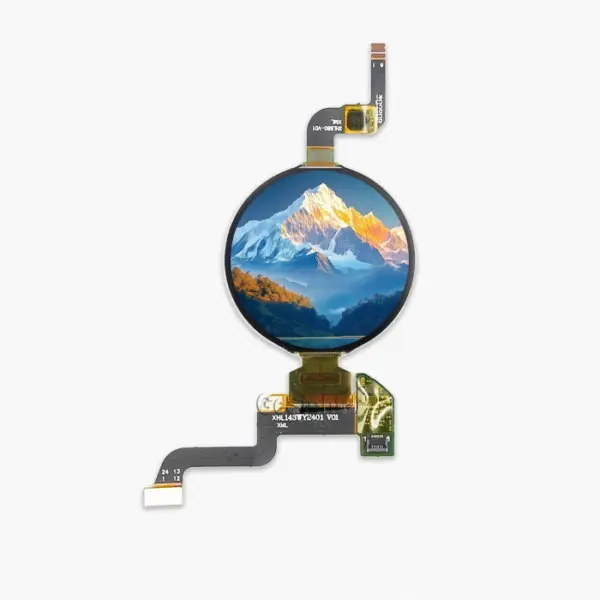
1.43-inch 466×466 AMOLED Display
| Size |
1.43 inch |
|---|---|
| Pixels |
466 × 466 |
| Interface | |
| Brightness |
700 cd/m² (typ, Ta=25℃, all-white, θ=0) |
| Manufacturer |
Gesight |
| Display Type |
AMOLED |
| Display Mode |
AMOLED / LTPS Glass |
| Color Depth | |
| Refresh Rate |
45 Hz (Frame Frequency fFRM) |
| Viewing Angle Range |
88° (Up/Down/Right/Left, Cr≥200) |
| Outline L*W*H |
44.75 × 44.75 × 2.58 mm |
| Active Area L*W |
36.35 × 36.35 mm |
| Orientation | |
| Supply Voltage |
VCC 2.7–3.6 V; IOVCC 1.65–3.3 V; ELVDD 3.25–3.35 V; ELVSS -3.35–-3.25 V |
| Consumption |
Full white (Sleep out): IVCC 2 mA typ (4 mA max); IIOVCC 1.5 mA typ (3 mA max); IELVDD/ELVSS 13 mA typ (19.5 mA max) |
| Operating Temperarure |
−30 to +70 °C |
| Storage Temperature |
−30 to +80 °C |
| Bezel Area (mm) |
4.20 mm per side |
| Aspect Ratio |
1:1 |
| Connection Type |
FPC |
| IC package |
COF |
| Touch Panel | |
| Pixel Pitch |
78 × 78 µm |
| Sunlight Readable |
– |
| Model |
TR143R2404A |
| PPI ( pixels per inch ) |
461 PPI |
| Application |
Touch interface pins listed; Touch signals present |
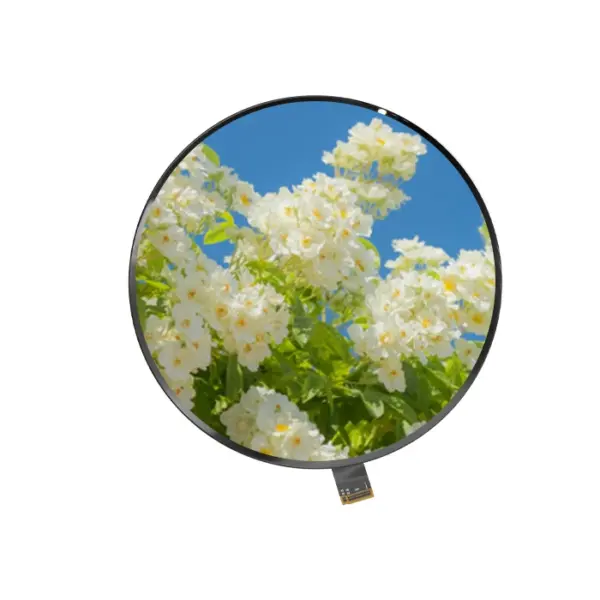
5.0-inch Circular TFT LCD 1080×1080 MIPI DSI
| Size |
5.0 inch |
|---|---|
| Pixels |
1080(RGB) × 1080 |
| Interface | |
| Brightness |
400 cd/m² (Typ.) |
| Manufacturer |
Gesight |
| Display Type |
IPS LCD ,TFT-LCD |
| Display Mode |
Normally Black, Transmissive mode |
| Color Depth | |
| Refresh Rate |
60 Hz |
| Viewing Angle Range |
U/D/L/R free viewing direction |
| Outline L*W*H |
136.531 × 132.208 × 1.98 mm |
| Active Area L*W |
127.008 × 127.008 mm (circle) |
| Orientation | |
| Supply Voltage |
IOVCC 1.8 V (typ); VSP +5.0 V (typ); VSN -5.0 V (typ); LED VF 38.4 V (typ); LED IF 20 mA (typ) |
| Consumption |
Backlight power 0.744 W (typ); 0.768 W (max) |
| Operating Temperarure |
-20 to +60 °C |
| Storage Temperature |
-30 to +75 °C |
| Bezel Area (mm) |
– |
| Aspect Ratio |
1:1 |
| Connection Type |
Board-to-board connector |
| IC package |
– |
| Touch Panel | |
| Pixel Pitch |
0.1176 × 0.1176 mm |
| Sunlight Readable |
– |
| Model |
PL050HDC |
| PPI ( pixels per inch ) |
305 |
| Application |
– |
Gesight Technology specializes in Round Display Screens, offering high-quality, customizable solutions with various interfaces and features. Available at wholesale prices, these screens can be purchased directly from the factory, ensuring cost-effectiveness and reliability.
Round Display Screen
What Is a Round Display Screen and How Does It Work?
A round display screen is a circular display panel commonly used in smartwatches, wearables, and IoT devices. It works by controlling pixels through LCD, TFT, or OLED technology, displaying images or data in a circular format. Interfaces like SPI, MIPI, or I²C connect the display to controllers or microprocessors for real-time output.
Which Round Display Screen Technologies Are Best for Different Applications?
TFT-LCD round screens are ideal for cost-effective, high-resolution industrial and embedded applications. OLED round displays offer high contrast, perfect blacks, and flexible designs for wearables. IPS LCD round screens provide wide viewing angles, making them suitable for consumer electronics and smartwatches. The choice depends on power, durability, and image quality requirements.
What Are the Best Round Display Screens for Smartwatches and Wearables?
OLED and AMOLED round displays are preferred for smartwatches and wearables due to their high contrast, vibrant colors, thin form factor, and energy efficiency. Flexible variants allow curved or ultra-thin designs, improving comfort and aesthetics while maintaining fast response times and durability for daily use.
How Are Round Display Screens Used in IoT and Embedded Systems?
Round displays in IoT and embedded systems present real-time data such as sensor readings, notifications, or graphical dashboards. Compact circular designs save space, while interfaces like SPI, I²C, or MIPI allow integration with microcontrollers and embedded processors for versatile industrial and consumer applications.
Which Round Display Screen Sizes and Resolutions Are Ideal?
Round display screens typically range from 1.2 inches to 3 inches for wearables, and larger sizes up to 7 inches for industrial or automotive use. Resolutions vary from 128×128 to 480×480 pixels, with higher resolutions preferred for detailed graphics, smart devices, or information-dense dashboards.
How Do You Connect and Integrate Round Display Screens with Microcontrollers?
Round displays connect via standard interfaces like SPI, I²C, MIPI DSI, or parallel RGB. Developers use controller boards or driver ICs to communicate with microcontrollers, enabling image rendering, touch input, and dynamic updates. Proper voltage, timing, and software drivers are critical for reliable performance.
What DIY Projects Can You Create with Round Display Screens?
Round displays are popular for DIY smartwatches, custom clocks, mini dashboards, IoT sensors, wearable devices, and hobbyist gadgets. They allow developers to experiment with circular graphics, animations, and real-time monitoring projects, combining touch input or external sensors for interactive applications.
How Do You Choose and Buy the Best Round Display Screen?
Choose a round display based on size, resolution, brightness, interface, power consumption, and durability. OLED offers better contrast, TFT-LCD is cost-effective, and IPS provides wide viewing angles. Reliable suppliers provide OEM/ODM options, engineering support, and compatibility with embedded controllers.
How Do You Troubleshoot and Maintain Round Display Screens?
Common troubleshooting includes checking interface connections, driver compatibility, power supply, and software settings. Regular maintenance involves keeping the surface clean, avoiding physical stress, and monitoring operating temperature. For touch displays, recalibration and firmware updates ensure accurate performance and longevity.
What Is the Future of Round Display Screen Technology?
Round display screens are evolving with flexible OLED, higher resolution, curved, and foldable designs. Future trends include ultra-thin panels, energy-efficient self-emissive displays, smart integration with wearable electronics, and advanced touch and sensor technologies for immersive IoT, automotive, and consumer applications.